Porfirii Fedorin
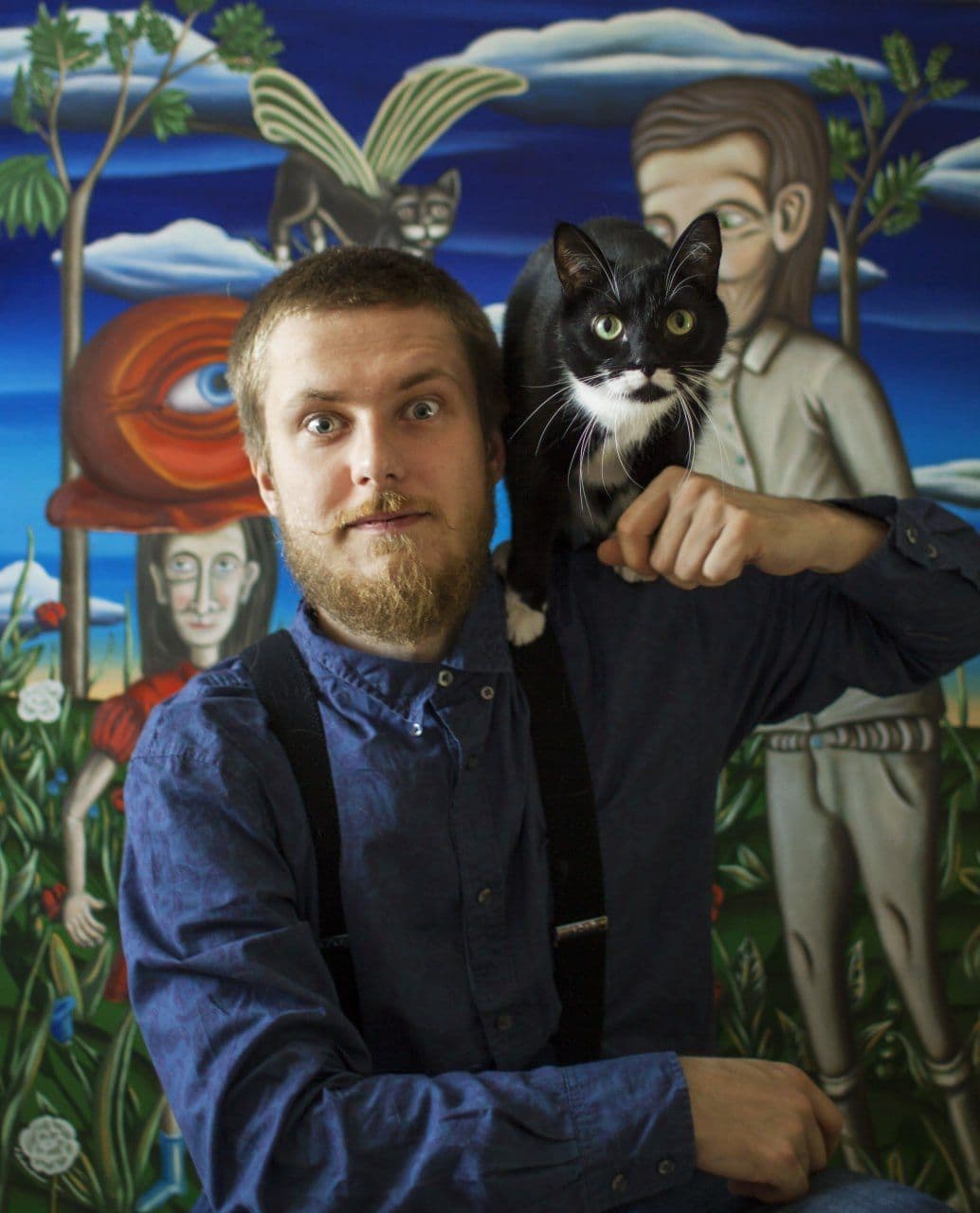
Porfirii Fedorin is a contemporary artist working at the intersection of symbolic systems, myth, and constructed cosmologies.
Born in Eastern Europe, his early visual environment was shaped by religious iconography and the spatial logic of sacred images. This influence persists not as quotation, but as structure — a disciplined approach to composition in which every element holds position, weight, and relation.
Fedorin's work does not follow the trajectories of either contemporary abstraction or narrative figuration. Instead, it develops a distinct direction often described as cosmogonic surrealism — a practice concerned not with depicting worlds, but with building them.
The paintings operate as systems rather than images.
Recurring elements — ascending forms, solar structures, serpentine lines, embedded figures — do not function as symbols in isolation, but as parts of an internally coherent order. Meaning emerges through relation, not representation.
Each work unfolds gradually. It resists immediate readability. What appears at first as complexity resolves into structure.
Fedorin's practice is grounded in construction.
Rather than improvisation or gesture, his compositions are assembled with precision — closer to architectural thinking than painterly expression. The image is treated as a field of forces, where balance, tension, and hierarchy determine form.
This results in works that feel both deliberate and unstable: ordered, yet not fully fixed.
Within the broader context of contemporary art, Fedorin's work stands apart through its refusal of immediacy.
Where much of contemporary visual culture moves toward reduction and speed, his paintings demand duration. They are not consumed quickly; they are navigated.
In this sense, his practice aligns more closely with the lineage of Hieronymus Bosch or Moebius — not stylistically, but structurally: in the creation of self-contained visual worlds governed by internal logic.
The works do not resolve at once. They remain — not as images, but as structures. Their form continues to shift in perception, changing with time, attention, and distance.
- Erarta Museum of Contemporary Art — Permanent collection, St. Petersburg
- Museum of St. Petersburg Art XX-XXI Centuries — Collection catalogue, Xochipilli (2011)
- Imago Mundi — Luciano Benetton Collection, International
- Google Arts & Culture — Digital archive
- Private collections in Argentina, Brazil, Russia, Thailand, the United States, and across Europe
- 2021 — Illuminations, Museum presentation, Moscow
- 2019–2020 — ART SCIENCE "2020 → 2070", Rusnano
- 2019 — "Actual Russia", Museum of Decorative and Folk Art, Moscow
- 2019 — "Traveling Through Dreams", ARTSTORY Gallery, Moscow
- 2018 — "Radical Fluidity. Grotesque in Art", MISP, St. Petersburg
- 2017 — "Fantasy in Everyday Life", Erarta Museum, St. Petersburg
- 2015 — "Cosmogony", Erarta Museum, St. Petersburg
- 2014 — "Portrait of a Family", Russian Museum, St. Petersburg
- 2014 — "Casus Pacis", Street Art Museum (MANIFESTA 10), St. Petersburg
- 2014 — "Advocates of Balalaika", Erarta Museum, St. Petersburg
- 2013 — "Cosmogony", Do-Gallery, St. Petersburg
- 2013 — "Micro Opere in Mostra", Galleria Vista, Rome, Italy
- 2013 — Imago Mundi, Luciano Benetton Collection, International
- 2012 — "Triumph of Caissa. Homage to Marcel Duchamp", Tretyakov Gallery, Moscow
- 2012 — "Mitki and Space", Memorial Museum of Cosmonautics, Moscow
- 2010 — "Sanatorium of Arts", Tretyakov Gallery at Krymsky Val, Moscow
- 2010 — "Libido", Central House of Artists, Moscow
- 2008 — "Russian Cosmos", Zverev Center of Contemporary Art, Moscow
Public profiles and collection references that help verify biography, provenance context, and institutional presence.
For press inquiries, exhibition proposals, and dossier requests: studio@fedorin.art