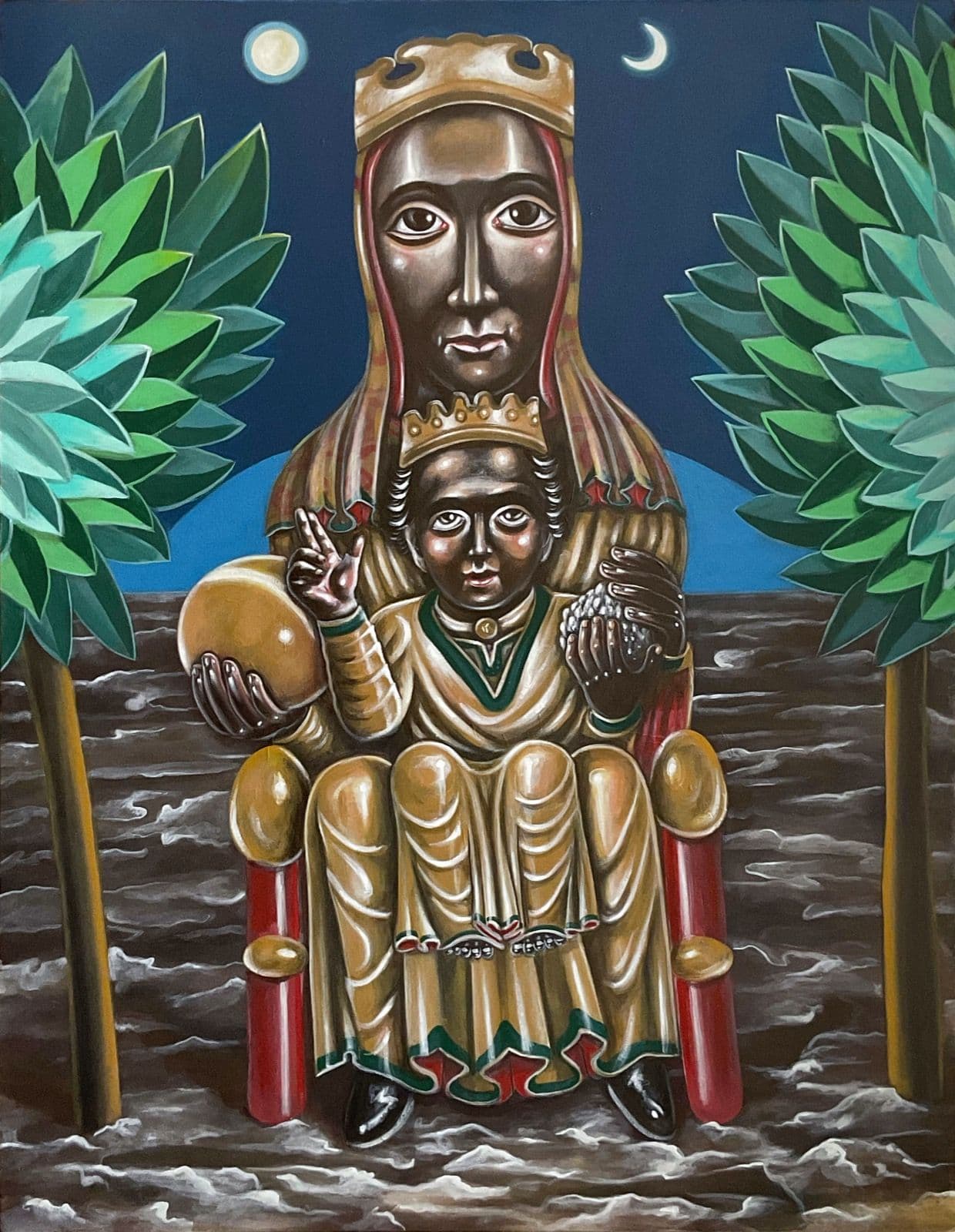
The Black Madonna in Contemporary Painting: A Painter's Guide to Virgen de Montserrat
There are images that survive every revolution in taste. The Black Madonna is one of them. For more than a thousand years, dark-skinned figures of the Virgin and Child have appeared in shrines from Catalonia to Częstochowa, from Switzerland to Brazil — pulling pilgrims, artists, and the simply curious out of their ordinary geographies and into a stranger one. When I painted Virgen de Montserrat in 2024, I was not attempting to revive a tradition. I was responding to a presence I could not avoid.
This essay is for collectors, curators, and viewers who want to understand what the Black Madonna actually is — not as a religious curiosity, not as a Wikipedia entry, but as a living image that contemporary painting can still meet. I write as a working oil painter, not as a theologian. What follows is the visual logic, the iconographic structure, and the painterly decisions behind a single canvas — and behind a tradition that refuses to age.
What is the Black Madonna?
The term "Black Madonna" describes a class of images of the Virgin Mary, usually with the Christ Child, in which the figures are rendered with dark skin — sometimes deliberately, sometimes as a result of centuries of candle smoke, oxidised silver, or aged varnish. Approximately 450 to 500 such images survive in Europe alone, with significant clusters in France, Spain, Italy, Poland, and Switzerland. Each carries its own legend. Each is, in its own community, considered miraculous.
Scholars have argued for decades about what the darkness means. Some attribute it to material accident: pine pitch, candle soot, oxidised pigment. Others trace it to deeper layers — pre-Christian goddesses absorbed into Marian devotion, Mediterranean and Near Eastern Mary traditions arriving via Crusader routes, the Cult of Isis lingering under a new name, or the cultural memory of dark-skinned Mediterranean women themselves. None of these explanations cancel the others. The Black Madonna is overdetermined: she is dark for many reasons at once, and the layered meanings are part of her power.
For a painter, the question of why she is dark matters less than the fact that she is. The darkness is a structural choice. It separates the Madonna from naturalism, from biographical portraiture, from the demand for a specific historical Mary. It places her in the territory of icon — image as presence rather than depiction.
The Virgen de Montserrat — Catalonia's Mountain Queen
The most famous Spanish Black Madonna sits in a basilica carved into the side of Montserrat, the serrated rock formation rising from the plain forty kilometres northwest of Barcelona. La Moreneta — "the little dark one" — is a 12th-century Romanesque wood carving, about 95 cm tall, gilded and seated, holding the Christ Child on her lap and a sphere in her right hand. Her face and hands are deep brown. Her clothes, originally polychrome, have darkened with age and smoke into a dense, almost lacquered surface.
The legend places her arrival in Catalonia in the first century, hidden in a cave during the Moorish occupation, rediscovered by shepherds following lights and music in 880. The history is more prosaic: she was likely carved in the late 1100s, modelled on an earlier Byzantine prototype that travelled west through the Mediterranean. But Catalans have venerated her for nearly nine hundred years as their patroness. Pilgrims still climb the mountain. The boys' choir, the Escolania, still sings the Salve at one o'clock each afternoon.
When I painted Virgen de Montserrat, I did not want to copy the Romanesque sculpture. I wanted to translate her. To carry her central gesture — the gravity of the seated mother holding the radiant child — into a language that a viewer in 2024 could meet without religious habit and without ironic distance. The figure in my canvas is not a portrait of La Moreneta. She is a presence built around the same axis: dark skin, child held with liturgical weight, sphere of light, world held still.
The Black Madonna Across Cultures
Her cousins are everywhere. The Madonna of Częstochowa in Poland — the Black Virgin, slashed across her cheek in a 14th-century desecration whose marks were preserved in every restoration. Notre-Dame du Puy in France. Tindari in Sicily, whose inscription reads Nigra sum sed formosa — "I am black but beautiful," from the Song of Songs. Einsiedeln in Switzerland. Rocamadour. Loreto. The list runs to hundreds.
Across the Atlantic, the same archetype appears under different names. Our Lady of Guadalupe — patroness of Mexico and the Americas — is dark-skinned, mestiza, an image that explicitly absorbed the indigenous goddess Tonantzin into Marian devotion. Aparecida in Brazil is darker still, found by fishermen in the Paraíba River in 1717. The pattern is consistent: where Christianity met older female deities of the earth, the moon, fertility, and the underworld, the resulting Marian image often took on a darker face.
For a contemporary painter living in Buenos Aires, this Mediterranean-to-Mesoamerican migration is not an academic detail. It is a working environment. The Catholicism of Argentina is layered with indigenous and African strata that have not been argued away. Painting a Black Madonna here means painting inside that overlay — not pretending it does not exist, not collapsing the differences, but acknowledging that the image has lived through many cultures and remains alive in all of them.
Why the Black Madonna Matters in Contemporary Painting
There is a temptation, in contemporary art, to treat traditional religious imagery as either dead matter to be quoted ironically or as a heritage object to be reproduced reverently. Both positions miss what makes the Black Madonna useful right now. She is a structural image: she carries authority, she carries memory, and she carries the unresolved question of what survives when an image outlasts its original framework of belief.
Painting her today is not nostalgia. It is a test of what painting itself can still do. Can a contemporary oil painting hold the kind of presence a 12th-century carving holds? Can it sustain the same gaze without collapsing into kitsch on one side or academic exercise on the other? The Black Madonna is a benchmark image precisely because she refuses easy outcomes. You cannot fake her. The painting will tell you, immediately, whether you have built something or merely arranged it.
In my own practice, the Sacred & Mythological series exists in part to ask this question repeatedly. Each canvas — Virgen de Montserrat, Samson Meets Lion, Saturn, An Angel with the Head of Saint John the Baptist — is a stress test. Some images survive the test. Some do not. The ones that do not are scraped down or stored. The ones that do form the series.
Painting Virgen de Montserrat — Process and Decisions
The canvas is 78 by 100 centimetres — large enough for the figure to feel monumental but small enough to remain intimate. The format echoes Romanesque altarpieces without imitating them. I worked on a primed linen ground, mid-grey, which gives the dark passages an immediate density and lets the highlights emerge as light rather than as added paint.
The composition is frontal. This is not a Renaissance Madonna, turned slightly to one side, caught in tender exchange with the child. This is an icon-position Madonna: she faces forward, the child sits on her lap aligned with her central axis, and both meet the viewer's gaze. Frontality is the formal grammar of presence. Three-quarter views are for portraits, for likeness, for individual character. Frontality is for figures who exist on the other side of representation — saints, guardians, deities.
The skin is built up from a deep umber base, glazed with thin layers of warm purple, raw sienna, and a final passage of cool blue in the deepest shadows. The technique is closer to Byzantine encaustic than to Northern European oil painting: the darkness is constructed in stages, each layer slightly modifying the previous, rather than mixed on the palette and applied directly. This is what gives Black Madonna skin its specific quality — a darkness that holds light from inside, rather than absorbing it on the surface.
On either side of the figure, two stylised palms rise into the night sky. They are not Mediterranean palms; they are not exact botanical specimens; they are palm-as-symbol, the heraldic palms of medieval altarpieces transformed into something more vegetative, almost serpentine. Above her, the moon and a thin crescent. The night sky is almost black, with a single passage of deeper warmth where the painting opens toward the unseen.
Iconographic Structure: How to Read the Painting
A Black Madonna painting carries a vocabulary. Once you learn the elements, you can read any version — including ones the artist did not consciously construct.
The mother's gaze: directed forward, not at the child. This is critical. She does not look at her son in this iconographic mode; she looks at the viewer. The gaze creates a triangle — viewer, mother, child — in which the mother becomes the threshold figure, the one who allows the relationship between us and the divine child to occur.
The child's position: seated on the mother's lap, often holding a book or a sphere, often raising one hand in blessing. In my Virgen de Montserrat the child holds the sphere — the world. This is the Christus Pantocrator gesture compressed into infancy: the cosmic ruler in the body of a child.
The hands: the mother's hands frame and present rather than embrace. There is no maternal tenderness in the modern Renaissance sense. There is liturgical gravity. She is not coddling her son; she is offering him to the world.
The setting: minimal, abstract, often a gold or starred ground in traditional icons. In my version, the night sky with palms and moon — a setting that places her in cosmic time rather than historical Galilee. This is consistent with the entire Black Madonna tradition. She does not exist in a specific landscape; she exists in a sacred geography, simultaneously here and elsewhere.
How to Look at a Contemporary Black Madonna
If you are encountering Virgen de Montserrat — or any contemporary Black Madonna painting — for the first time, here is what to attend to.
First: spend time on the gaze. Allow it to look back. Most paintings do not require this kind of duration. Black Madonna paintings do. The image is constructed to address the viewer directly; if you scroll past it, you have not really seen it. Stand for at least a minute. Notice when your own breathing slows.
Second: read the surface. A serious oil painting, especially one in this tradition, will reward inspection at multiple distances. From two metres, you see the figure. From thirty centimetres, you see the construction — the layered glazes, the impasto highlights, the underdrawing emerging through thin passages. This double-distance experience is part of what oil painting can do that no other medium can.
Third: locate the iconographic anchors. Is the gaze frontal? What is in the child's hands? What is the setting — gold ground, night sky, landscape, abstract? These structural decisions tell you what tradition the painter is in conversation with, and how seriously they are taking it.
Fourth: ask whether the image is alive. This is the only test that finally matters. A dead Madonna is a quotation, a curiosity, a clever postmodern wink. A living Madonna does not need belief from you to function. She works whether you are Catholic, secular, Jewish, agnostic, or hostile to religious imagery. If the painting holds you, it holds you. The Black Madonna is, in this sense, an entirely democratic image — she does not ask for credentials.
The Black Madonna in 2024: Why Now
Why paint a 12th-century Catalan icon in 2024? Because the questions she carries have not been resolved. The relationship between the sacred and the secular, between maternal authority and divine authority, between dark skin and divinity in a Christian iconographic tradition that has often whitened her — these are live questions. Painting her is one way to keep them open.
There is also a more local reason. The contemporary art world has spent fifty years systematically draining religious and mythological subjects of their seriousness, treating them as raw material for irony or for identity-political critique. Both moves have their place. But neither produces images that can hold the kind of attention the Black Madonna has held for nine centuries. To restore that capacity — to make a painting that can sit on a wall and remain alive across years of attention — is one of the things a working painter can usefully do right now.
The Virgen de Montserrat in my Sacred & Mythological series is one attempt at this. There will be others. The tradition is large and the painter's lifetime is short.
Where to See the Painting
The original Virgen de Montserrat (oil on canvas, 78 × 100 cm, 2024) is part of the Sacred & Mythological series and is available on request through collector inquiry. A limited edition giclée print of the work, in an edition of 25, signed and numbered, printed on Hahnemühle 308 gsm fine art paper with a certificate of authenticity, is available through the Editions section of fedorin.art. Inquiries: studio@fedorin.art.
For viewers who want to see the original Romanesque La Moreneta in person, the basilica at Montserrat is open daily, with the Salve at 13:00 and Vespers at 18:45 — except during periods of pilgrimage or restoration, which are announced on the abbey website. The mountain itself, which the medieval Catalans called serra serrada — the cut serrated mountain — is worth the climb regardless of devotional intent. The Black Madonna chose her geography well.
Move from the essay to the work.
Open the related work, series, or collector route, or contact the studio for availability and a concise dossier.