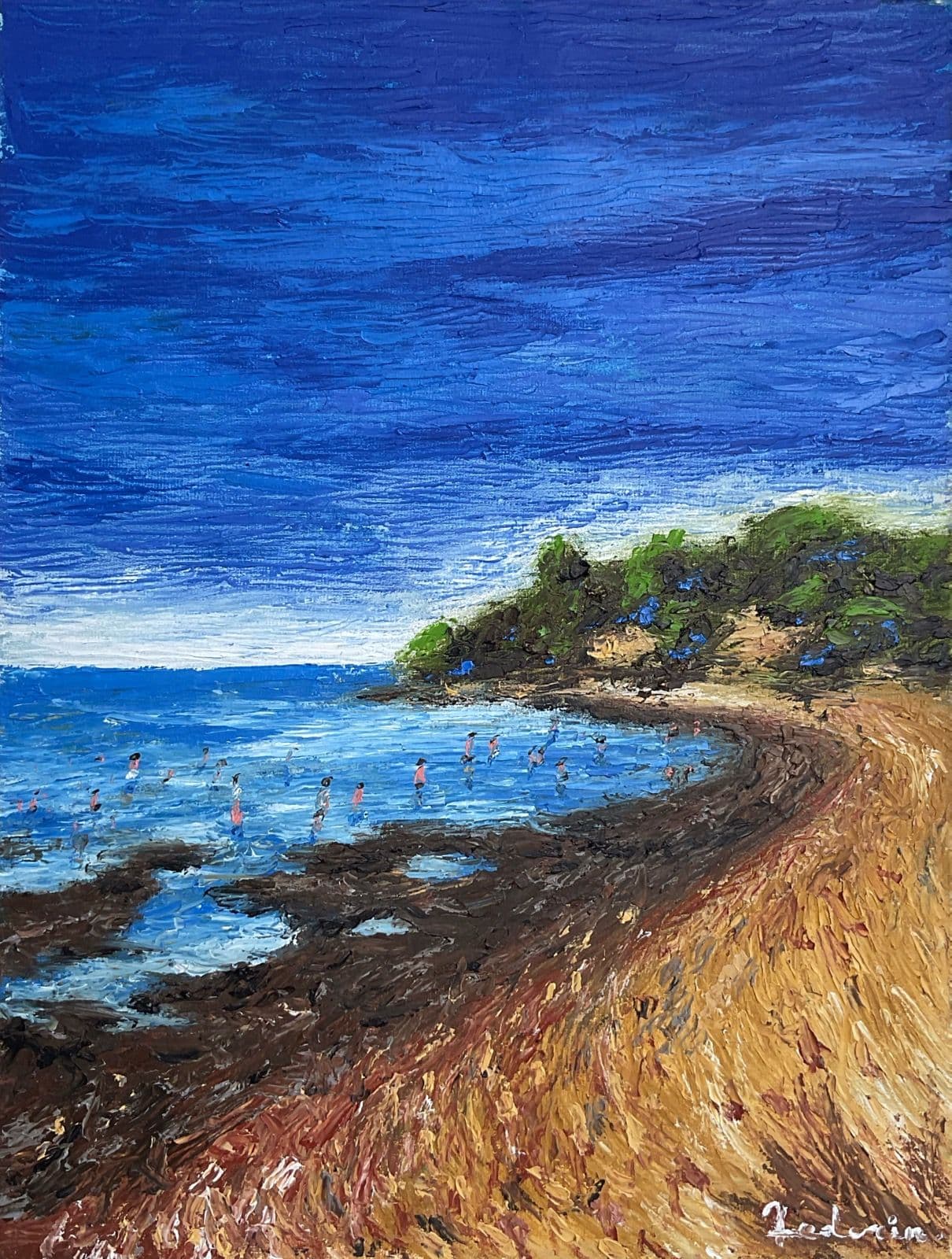
Buenos Aires Landscapes: Painting the City I Live In
I did not come to Buenos Aires to paint landscapes. I came for reasons that were personal, intuitive, barely articulable. But the city changed my painting almost immediately — the light, the color, the physical weight of the air. As an Argentine painter by choice if not by birth, I found in this city a landscape that demanded to be painted with a new kind of force.
The Light of Buenos Aires
Buenos Aires art is shaped by a light that is nothing like European light. It is horizontal, warm, almost aggressive in its clarity. Shadows are short and sharp. Colors are not muted by mist or grey skies — they arrive at full saturation, unapologetic. This is a city where the trees in a park can look blue, where the earth is genuinely red, where the sea at the Reserva Ecológica is grey-green and thick with sediment from the Río de la Plata.
When I painted Plaza Sicilia, I was accused of exaggerating the colors. I was not. The blue trunks, the vivid green canopies, the red earth — these are what I see. Landscape painting in a contemporary context means painting what is actually there, not what convention expects.
Impasto and the Argentine Landscape
The thickness of my paint in the Buenos Aires landscapes is a direct response to the thickness of the light. Playa Reserva is built from layers of impasto so physical that the canvas has real topography — you could almost feel the heat radiating from the surface. This is not landscape painting as distant observation. It is landscape painting as bodily experience.
An Argentine painter works differently from a Northern European landscapist. There is no atmospheric perspective here — everything is close, present, immediate. The palette is warm. The air is dense. The appropriate response is thick, saturated oil paint applied with confidence and force.
Buenos Aires as an Inner Geography
Over the years, Buenos Aires has become more than a location for my landscape painting. It has become part of the inner cosmology that governs all my work. The same light that illuminates my park scenes illuminates my saints and guardians. The same red earth that grounds Plaza Sicilia grounds the mythological landscapes behind my sacred figures. The city is not a backdrop. It is a participant — a living geography that has entered the mythology and refuses to leave.
Move from the essay to the work.
Open the related work, series, or collector route, or contact the studio for availability and a concise dossier.