Visionary Art: Tradition and Practice
The term "visionary art" is often used loosely — applied to anything that looks strange, psychedelic, or otherworldly. But visionary painting, understood properly, belongs to one of the oldest traditions in human culture: the attempt to make visible what ordinary sight cannot reach.
The Visionary Tradition
Visionary art has its roots not in galleries but in temples. The icons of Byzantium, the illuminated manuscripts of medieval Europe, the cosmic diagrams of Hindu and Buddhist traditions, the Aztec codices — all of these are visionary works in the deepest sense. They do not depict what the artist saw with physical eyes. They render what was perceived through an inner faculty: revelation, meditation, dream, or disciplined imagination.
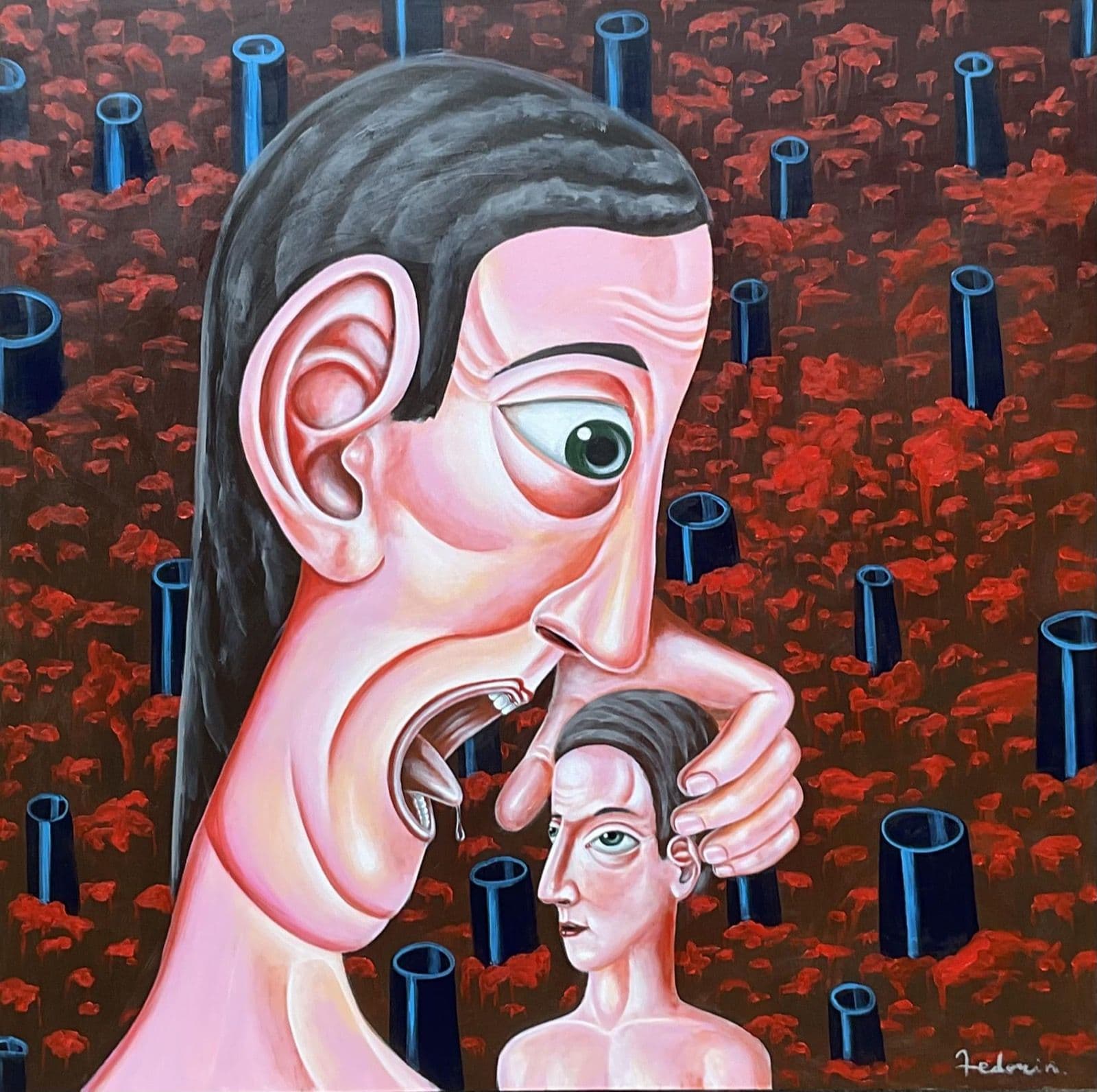
As a contemporary visionary artist, I position my work within this lineage — not as imitation, but as continuation. The figures in my Sacred & Mythological series — Virgen de Montserrat, Saturn, Samson — are not illustrations of scripture. They are images that arrived with the force of inner necessity, the way visions arrive: unbidden, complete, demanding to be made physical.
Visionary Painting vs. Fantasy
The crucial distinction is this: fantasy invents. Visionary painting discovers. A fantasy artist creates creatures for entertainment. A visionary painter encounters beings that feel as though they already existed — in a dream, in a myth, in a stratum of consciousness older than the individual mind. The difference is not in the strangeness of the image but in the quality of attention behind it.
My creatures — the Pink Buffalo, the Chief Dove, the many-eyed guardians — are not designed. They emerged. I cannot explain them any more than I can explain a dream. But I can tell you that they carry a specific weight, a specific presence, that pure invention does not produce.
A Practice of Seeing
Visionary art is not only a product but a practice. It requires training the eye to see beyond surfaces, training the hand to follow images that have no photographic reference, and training the mind to remain open to what cannot be rationally explained. For me, the studio is not a workshop — it is an observatory. I do not make things up. I wait until something appears, and then I build it as faithfully as I can.
Move from the essay to the work.
Open the related work, series, or collector route, or contact the studio for availability and a concise dossier.