Mythological Painting in Contemporary Art
Mythological art is often dismissed as anachronistic — an artifact of Renaissance patronage or academic tradition that has no place in the contemporary world. I believe the opposite. Mythology in painting is more necessary now than ever, precisely because it addresses the dimension of experience that contemporary life most aggressively suppresses: the sacred, the archetypal, the irreducibly strange.
Myth Is Not Illustration
The most common misunderstanding of mythological painting is that it illustrates pre-existing stories — that a painting of Saturn devouring his son is simply a visualization of Ovid or Hesiod. But the great mythological painters — Goya, Blake, Redon, Ernst — never illustrated. They inhabited. They entered the myth as a living space and reported what they found there.
This is what I attempt in my own work. My Saturn is not Goya's Saturn, though it acknowledges the lineage. It is a Saturn discovered in the same psychic territory — the place where the archetype of the devouring father exists as a permanent structure of human consciousness. Contemporary mythology art, at its strongest, does not retell old stories. It accesses the same sources those stories came from.
The Mythological Image Today
In a culture saturated with images — most of them disposable, most of them designed for instant consumption — the mythological painting offers something rare: an image that cannot be quickly consumed. It demands time, attention, knowledge. It rewards repeated viewing. It grows in the mind after the viewer walks away.
Mythology in painting provides a framework for addressing subjects that contemporary art often avoids: the sacred, death, transformation, the encounter with the non-human. My Sacred & Mythological series engages all of these. The Virgen de Montserrat is not a nostalgic gesture toward Catholic imagery — it is a living encounter with the archetype of the divine mother, painted from within, not from outside.
Building a Contemporary Mythology
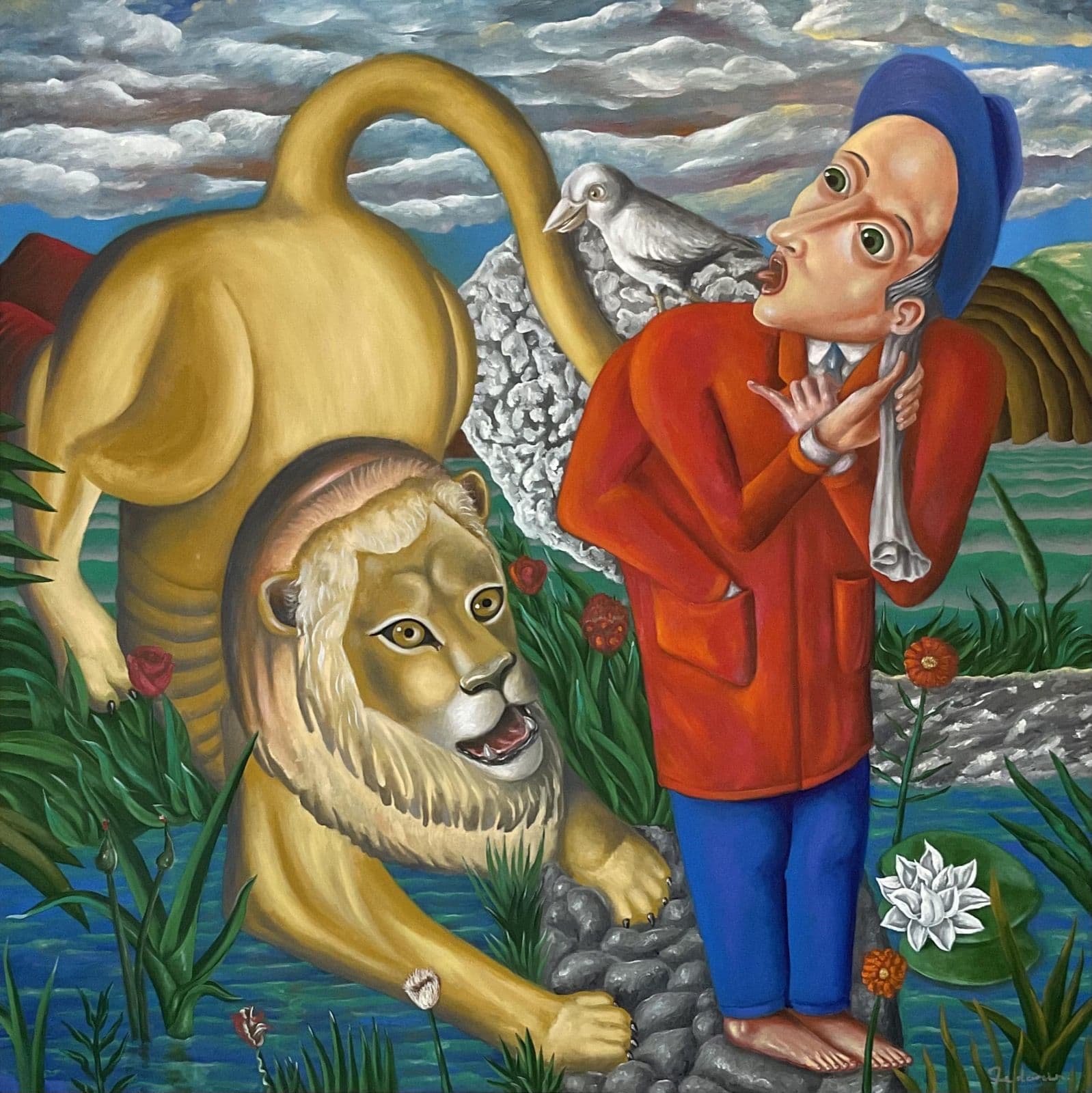
What distinguishes my approach to mythological art from purely traditional practice is the insistence on building rather than borrowing. The mythology in my work is not Greek, not Christian, not pre-Columbian — though it draws on all of these. It is personal. It is a system of recurring figures, motifs, and encounters that has developed over two decades of painting. The creatures, the guardians, the sacred figures: they form a mythology that belongs to no tradition and to all of them at once.
Move from the essay to the work.
Open the related work, series, or collector route, or contact the studio for availability and a concise dossier.